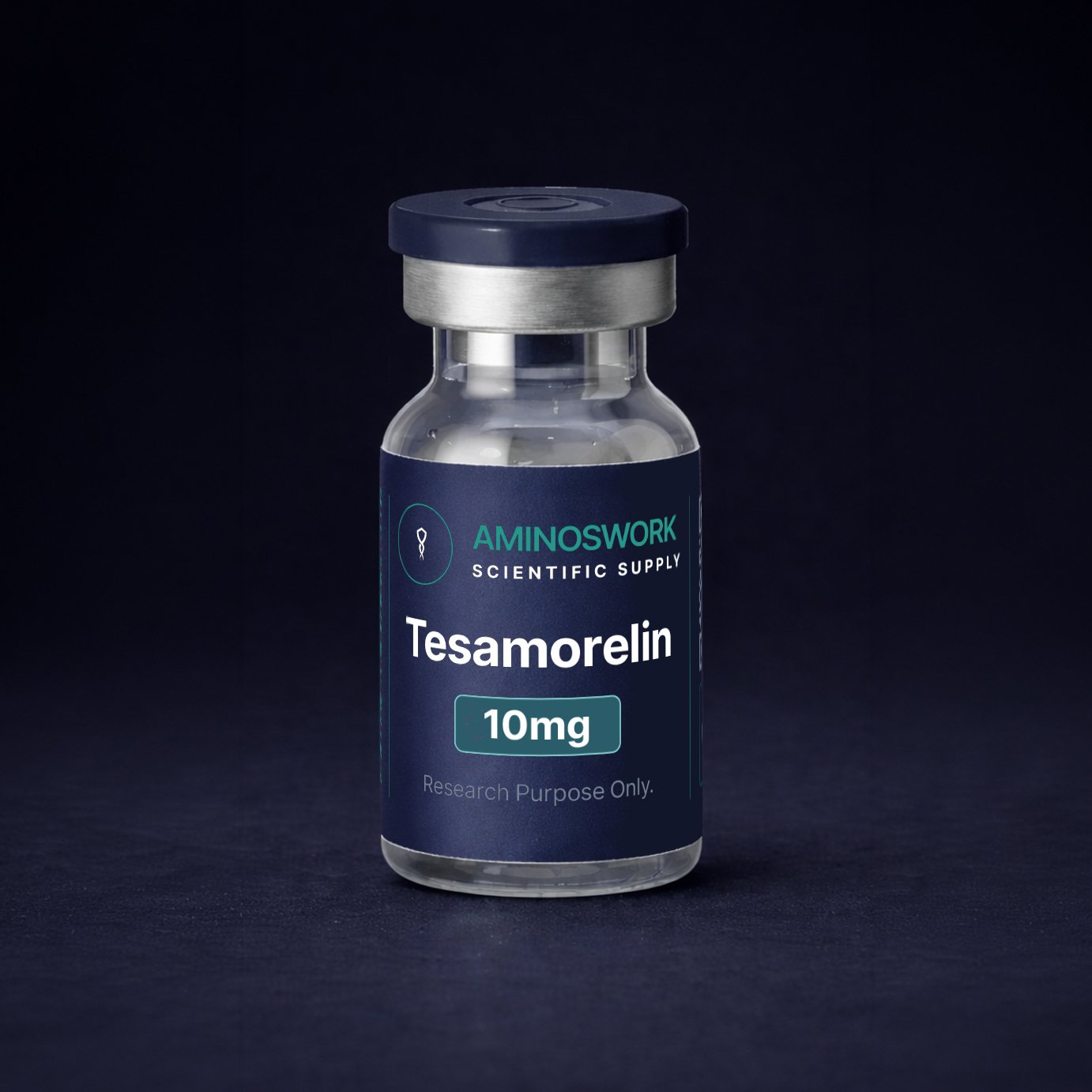
Tesamorelin

CAS: 218949-48-5

|

SKU:Tesamorelin

Tesamorelin is a synthetic analogue of growth hormone–releasing hormone (GHRH) developed for laboratory investigation of GHRH receptor signaling, pulsatile endocrine regulation, and downstream metabolic signaling pathways in controlled research environments.
Current Lot ID
2602-C116-10-001
Third-party analytical validation via HPLC & MS / Sequence matching verified

Research Use Only

This product is intended for research purposes only.

Configure Order

Select quantity and verify pricing.
SELECT CONCENTRATION
VOLUME PRICING
1
Technical Specification

Scientific Context & Applications

Research Profile Access

View extended technical data, molecular targets, signaling pathways, and historical research timelines for Tesamorelin

Scientific Context
Molecular classification and background.

Tesamorelin is a stabilized synthetic GHRH analogue modified with a trans-3-hexenoic acid group at the N-terminus, a structural adaptation that confers resistance to enzymatic degradation by dipeptidyl peptidase-4 (DPP-4). In laboratory research models, Tesamorelin has been examined for its involvement in:
  • GHRH receptor–mediated signaling pathways
  • cAMP-dependent intracellular signaling cascades
  • Pulsatile growth hormone secretion dynamics
  •  Adipose-tissue–associated metabolic signaling mechanisms
All findings are derived from controlled non-clinical experimental systems and interpreted strictly at the molecular and cellular level.

Laboratory Applications
Experimental models and settings.

Tesamorelin is utilized in non-clinical research environments as a GHRH-pathway probe to investigate endocrine and metabolic signaling mechanisms. Reported experimental applications include:
  • Adipose Tissue Research: Investigated in laboratory models to study signaling pathways associated with visceral adipose tissue regulation.
  • Metabolic Profiling Studies: Used to evaluate changes in lipid-associated signaling markers and glucose-related metabolic pathways.
  • Vascular Marker Investigation: Investigated in experimental systems examining endothelial and vascular signaling responses linked to metabolic stress.
  • Cognitive and Neuroendocrine Models: Applied in research models assessing interactions between GHRH signaling and central nervous system function.

Scientific References
Peer-reviewed literature data.

  • Falutz J, et al. (Falutz J, et al.).“Effects of tesamorelin on visceral fat.”JAIDS
  • Ferdinandi ES, et al. (Ferdinandi ES, et al.).“Tesamorelin pharmacokinetics.”Basic Clin. Pharmacol. Toxicol.
  • Stanley TL, et al. (Stanley TL, et al.).“Tesamorelin and body composition.”J. Clin. Endocrinol. Metab.
  • Baker LD, et al. (Baker LD, et al.).“GHRH effects on cognition.”Archives of Neurology

Related Research Compounds

Explore compounds frequently investigated in similar research domains and signaling pathways.

GLP2-T

2023788-19-2

Thymosin Alpha-1 (TA1)

62304-98-7

Tesamorelin

218949-48-5

Selank

129954-34-3

GLP3-R

2381089-83-2

PT-141

189691-06-3