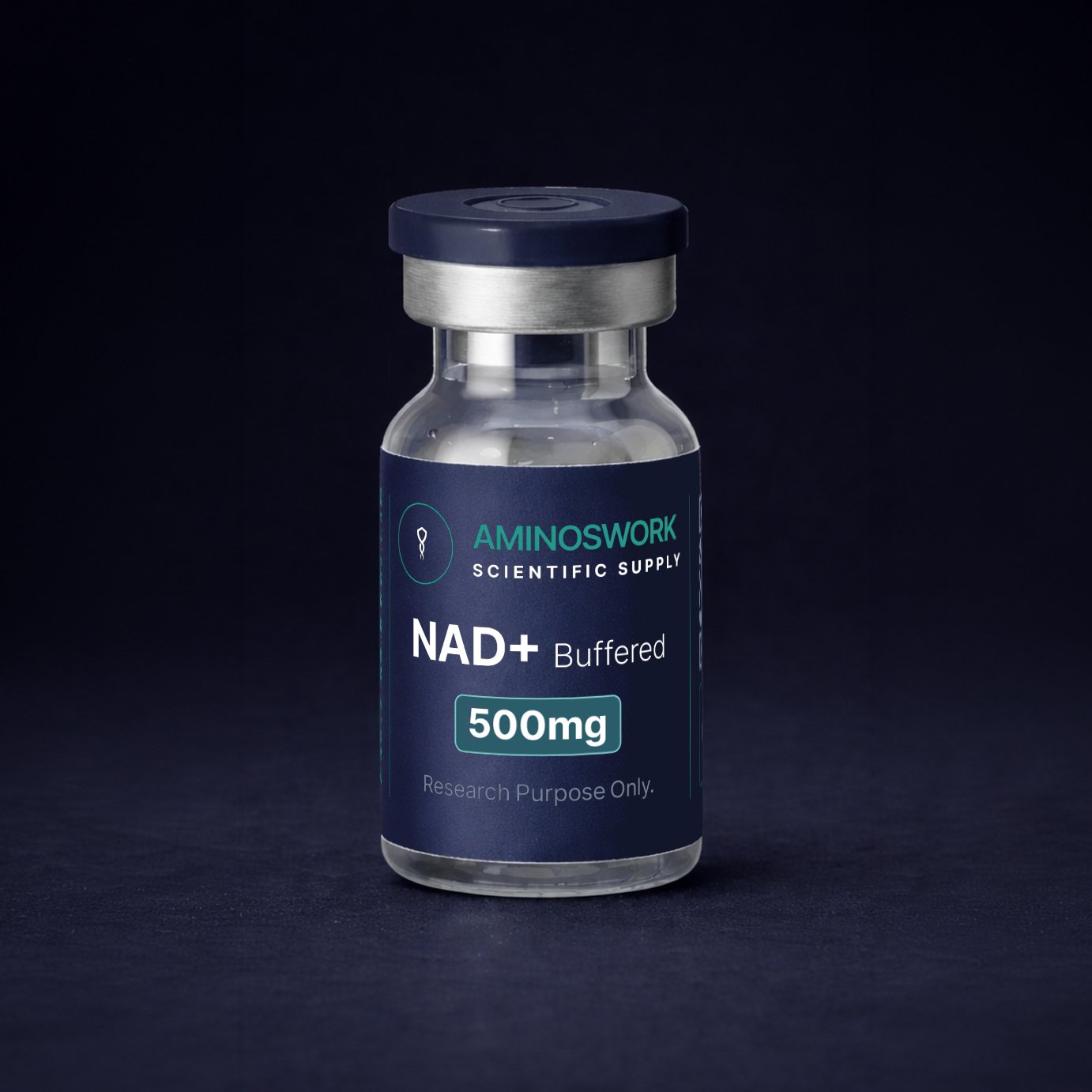
NAD+ Buffered

CAS: 53-84-9

|

SKU:NAD+ Buffered

NAD+ Buffered is a laboratory-grade formulation of Nicotinamide Adenine Dinucleotide investigated in controlled research environments for its role in cellular redox balance, metabolic signaling, and NAD+-dependent enzymatic pathways.
Current Lot ID
2602-C114-500-001
Third-party analytical validation via HPLC & MS / Sequence matching verified

Research Use Only

This product is intended for research purposes only.

Configure Order

Select quantity and verify pricing.
SELECT CONCENTRATION
VOLUME PRICING
1
Technical Specification

Scientific Context & Applications

Research Profile Access

View extended technical data, molecular targets, signaling pathways, and historical research timelines for NAD+ Buffered

Scientific Context
Molecular classification and background.

Nicotinamide Adenine Dinucleotide (NAD⁺) is an essential intracellular coenzyme central to cellular energy metabolism and redox homeostasis. In laboratory research models, NAD⁺ functions as an electron carrier in oxidation–reduction reactions and serves as a substrate for multiple NAD⁺-dependent enzyme families. Experimental investigations have examined NAD⁺ for its involvement in:
  • Sirtuin-associated deacetylation and transcriptional regulation
  • Poly(ADP-ribose) polymerase (PARP)–mediated DNA repair signaling
  • CD38-related NAD⁺ turnover and calcium-associated signaling
  • Mitochondrial function and metabolic flux regulation
All observations are derived from controlled non-clinical experimental systems and interpreted strictly at the molecular and cellular research level.

Laboratory Applications
Experimental models and settings.

Experimental models and investigational settings.
  • Sirtuin Activity Assays: Utilized in cell-based systems to examine NAD⁺-dependent deacetylase signaling pathways.
  • Genotoxic Stress Models: Applied in laboratory environments evaluating PARP-associated DNA repair mechanisms.
  • Neuronal Signaling Research: Investigated in in-vitro models examining axonal integrity and NAD⁺-linked stress responses.
  • Metabolic Pathway Mapping: Used in isotope-tracing studies to assess NAD⁺ biosynthesis and recycling pathways.
All applications are limited to non-clinical research environments.

Scientific References
Peer-reviewed literature data.

  • Imai S, et al. (Imai S, et al.).“NAD+ and sirtuins.”Nature
  • Verdin E. (Verdin E.).“NAD+ in aging and disease.”Science
  • Yoshino J, et al. (Yoshino J, et al.).“NAD+ biosynthesis and metabolic function.”Cell Metabolism
  • Gerdts J, et al. (Gerdts J, et al.).“SARM1 and NAD+ depletion in axons.”Neuron

Related Research Compounds

Explore compounds frequently investigated in similar research domains and signaling pathways.

Hospira Bac Water – 30ml

Kisspeptin

374675-21-5

GLP1-S

910463-68-2

5-Amino-1MQ

42464-96-0

Immune & Inflammatory Signaling Bundle

GH Axis & Endocrine Signaling Bundle

Neuro-Signaling & Neuropeptide Bundle

Mitochondrial & Cellular Energy Bundle

Structural & Cytoskeletal Research Bundle