
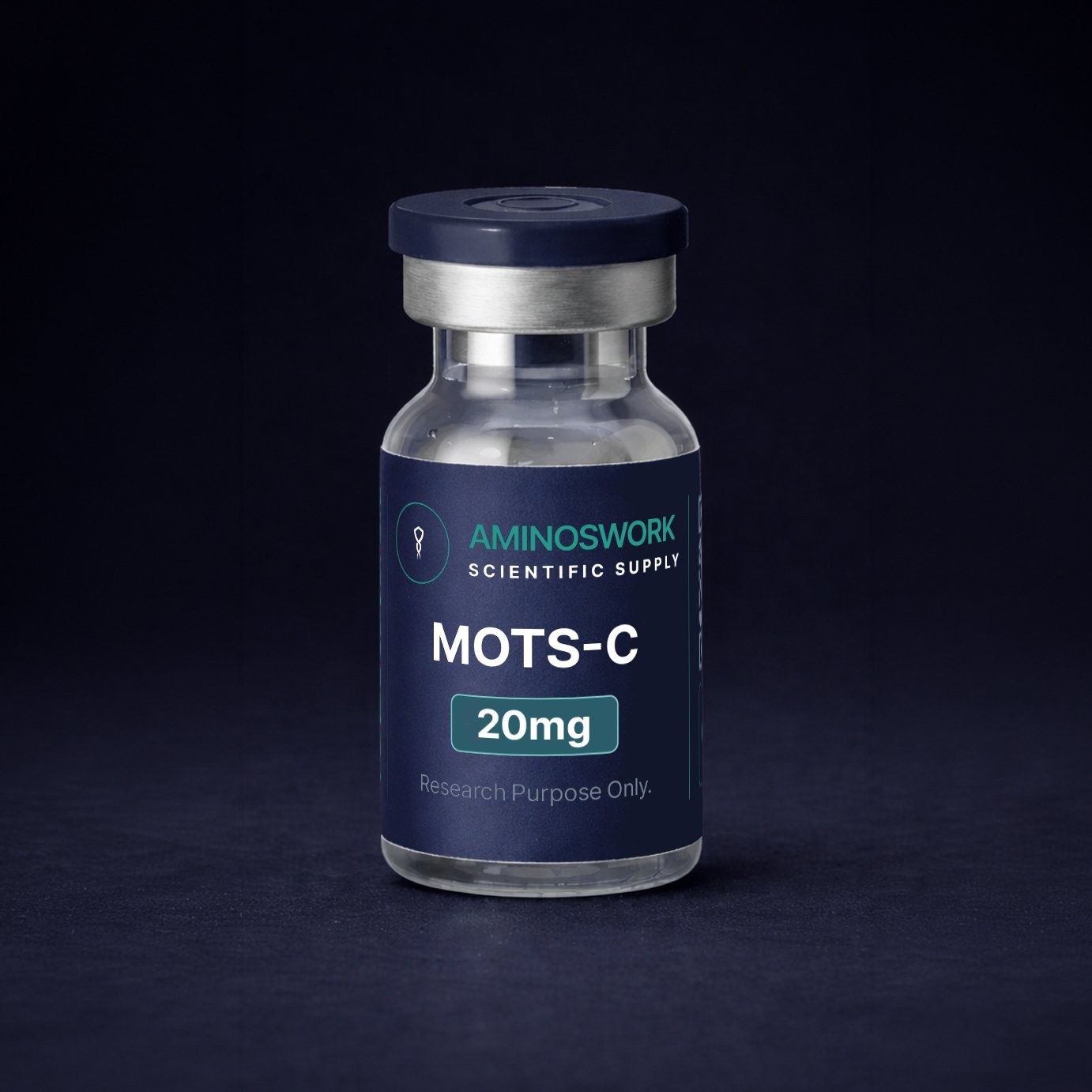
MOTS-c

CAS: 1627580-64-6

|

SKU:MOTS-C

MOTS-c is a mitochondrial-encoded peptide investigated in laboratory research for its role in cellular metabolic signaling, stress-response adaptation, and energy-regulation pathways in controlled experimental models.
Current Lot ID
2602-C113-10-001, 2602-C108-40-001
Third-party analytical validation via HPLC & MS / Sequence matching verified

Research Use Only

This product is intended for research purposes only.

Configure Order

Select quantity and verify pricing.
SELECT CONCENTRATION
VOLUME PRICING
1
Technical Specification

Scientific Context & Applications

Research Profile Access

View extended technical data, molecular targets, signaling pathways, and historical research timelines for MOTS-c

Scientific Context
Molecular classification and background.

MOTS-c (Mitochondrial Open Reading Frame of the 12S rRNA-c) is a peptide encoded within the mitochondrial genome. In laboratory research models, MOTS-c has been characterized as a mitochondrial-derived signaling peptide capable of translocating to the nucleus under conditions of metabolic stress. Experimental investigations have examined MOTS-c for its involvement in:
  • AMP-activated protein kinase (AMPK)–associated signaling pathways
  • Folate- and methionine-cycle–linked metabolic regulation
  • Nuclear transcriptional modulation during cellular stress
  • Glucose-associated metabolic signaling mechanisms
All observations are derived from controlled non-clinical experimental systems and interpreted strictly at the molecular and cellular research level.

Laboratory Applications
Experimental models and settings.

Experimental models and investigational settings.
  • Metabolic Stress Models: Utilized in laboratory systems examining cellular adaptation to nutrient stress and altered metabolic states.
  • Energy Regulation Research: Applied in experimental models assessing AMPK-associated signaling dynamics.
  • Bone and Differentiation Studies: Investigated in research systems exploring peptide-associated regulation of osteogenic signaling pathways.
  • Cellular Senescence Models: Used in in-vitro environments examining markers associated with stress-response and aging-related signaling.
All applications are limited to non-clinical research environments.

Scientific References
Peer-reviewed literature data.

  • Lee C, et al. (Lee C, et al.).“The mitochondrial-derived peptide MOTS-c.”Cell Metabolism
  • Kim KH, et al. (Kim KH, et al.).“MOTS-c and metabolism.”Scientific Reports
  • Reynolds JC, et al. (Reynolds JC, et al.).“MOTS-c and physical performance.”Geroscience
  • Lu H, et al. (Lu H, et al.).“MOTS-c and bone health.”Journal of Bone and Mineral Research

Related Research Compounds

Explore compounds frequently investigated in similar research domains and signaling pathways.

NAD+ Buffered

MOTS-c

1627580-64-6

Ipamorelin

170851-70-4

HGH Fragment 176-191

66004-57-7

Glutathione