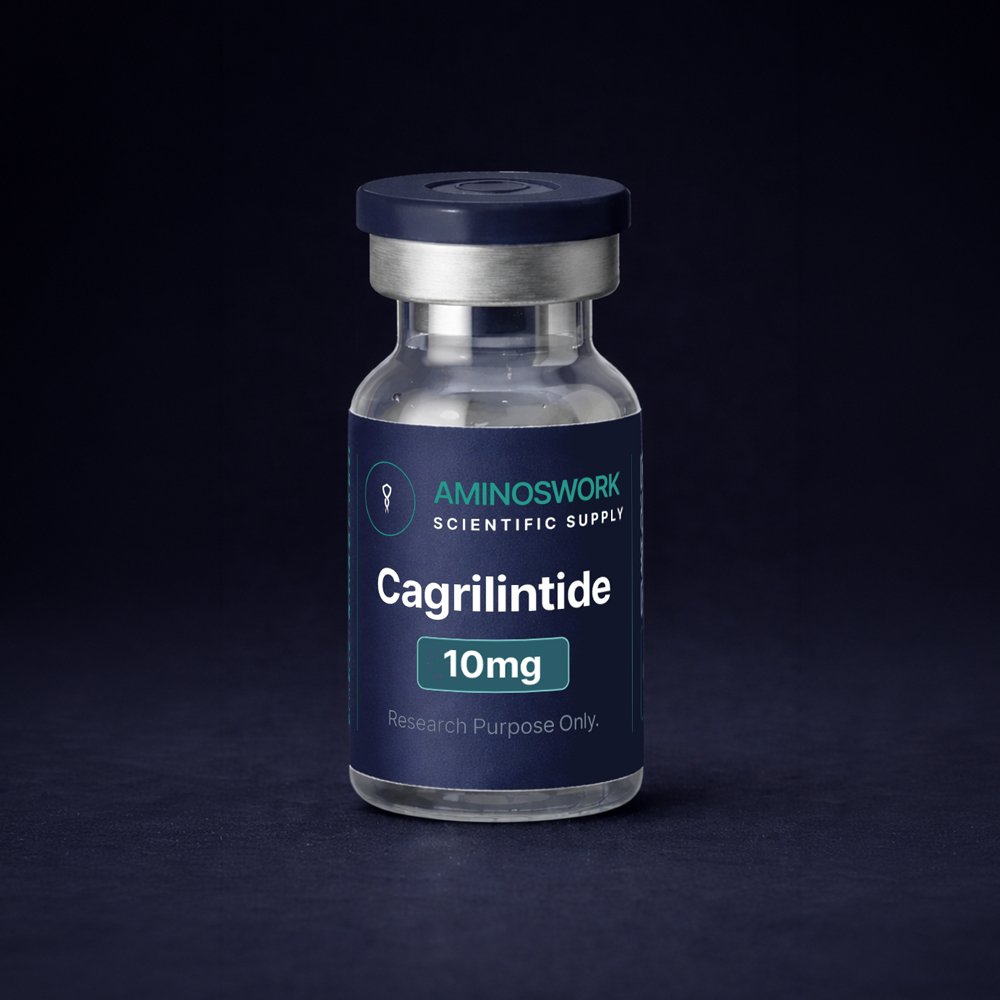
Cagrilintide

CAS: 1415456-99-3

|

SKU:Cagrilintide

Cagrilintide is a synthetic, long-acting acylated peptide analogue of amylin (islet amyloid polypeptide, IAPP) developed for laboratory research involving amylin-associated receptor signaling and peptide stabilization strategies.
Current Lot ID
2602-C134-10-001
Third-party analytical validation via HPLC & MS / Sequence matching verified

Research Use Only

This product is intended for research purposes only.

Configure Order

Select quantity and verify pricing.
SELECT CONCENTRATION
VOLUME PRICING
1
Technical Specification

Scientific Context & Applications

Research Profile Access

View extended technical data, molecular targets, signaling pathways, and historical research timelines for Cagrilintide

Scientific Context
Molecular classification and background.

Cagrilintide is classified as a long-acting amylin receptor research peptide incorporating lipid-based structural modifications designed to extend molecular stability and persistence in experimental systems. In laboratory research models, Cagrilintide has been used to examine:
  • Amylin (AMY) receptor–associated signaling pathways
  • Calcitonin (CTR) receptor interactions and cross-reactivity
  • Central nervous system signaling mechanisms related to peptide hormones
The lipidation of the peptide facilitates reversible albumin association, which is leveraged in research to study peptide half-life extension and sustained receptor engagement under controlled conditions. All observations are limited to molecular and cellular research contexts and do not imply functional or clinical outcomes.  

Laboratory Applications
Experimental models and settings.

Cagrilintide is utilized in non-clinical research environments as a signaling probe for investigating amylin-associated pathways and peptide pharmacokinetics. Reported experimental contexts include:
  • Central Neural Signaling Studies Used in laboratory models to examine amylin-mediated receptor signaling patterns within brain-derived cellular systems.
  • Multi-Hormone Signaling Research Applied in experimental models to explore interactions between amylin-related pathways and other metabolic receptor systems, without outcome framing.
  • Gastrointestinal & Metabolic Signaling Models Examined in controlled laboratory assays to investigate peptide-mediated intracellular signaling responses in relevant cell types.
  • Peptide Stability & Structural Optimization Research Utilized to study acylation-based strategies for extending peptide persistence in experimental systems.
All applications remain strictly investigational and confined to laboratory research use only. Research involving Cagrilintide is exploratory and model-dependent. Findings observed in cellular or animal research systems do not predict outcomes in humans or animals outside controlled laboratory environments. No conclusions regarding safety, efficacy, metabolic effects, or clinical relevance have been established.

Scientific References
Peer-reviewed literature data.

Selected peer-reviewed literature examining amylin analogue design and receptor signaling mechanisms:
  1. Kruse T, et al. Design and development of long-acting amylin analogues. Journal of Medicinal Chemistry
  2. Dehestani B, et al. Amylin receptor pathway characterization in experimental systems. Neuroendocrinology
  3. Boyle CN, et al. Amylin-associated neural signaling mechanisms. Physiology & Behavior
  4. Lutz TA. Amylin receptor signaling dynamics. Physiology & Behavior
(Clinical efficacy, weight-related outcomes, and therapeutic studies are intentionally excluded from commerce pages.)

Related Research Compounds

Explore compounds frequently investigated in similar research domains and signaling pathways.

GLP2-T

2023788-19-2

Thymosin Alpha-1 (TA1)

62304-98-7

Tesamorelin

218949-48-5

Selank

129954-34-3

GLP3-R

2381089-83-2

PT-141

189691-06-3