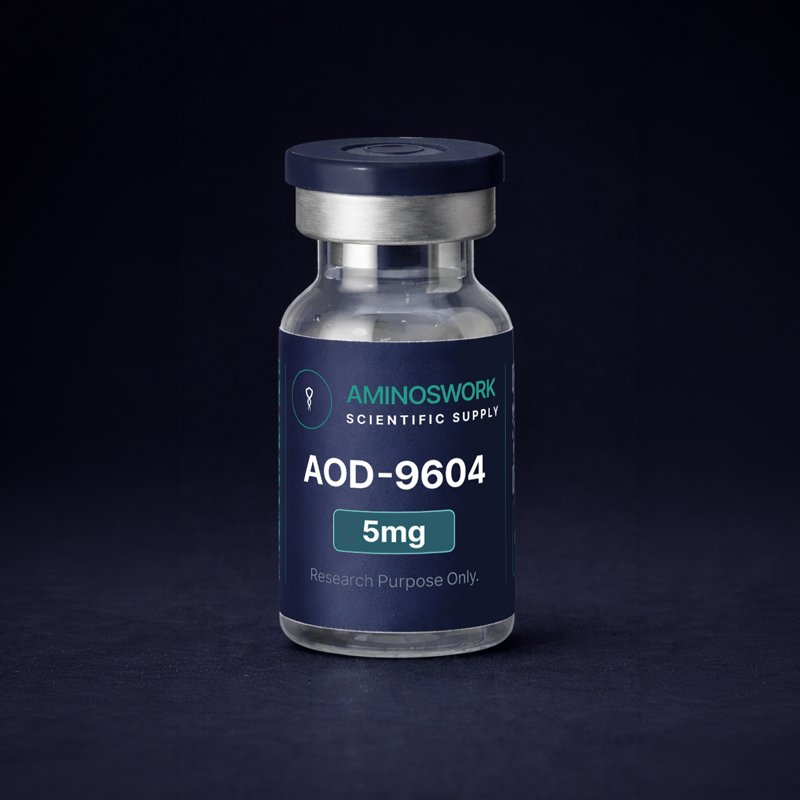
AOD-9604

CAS: 221231-10-3

|

SKU:AOD-9604

AOD-9604 is a synthetic peptide derived from amino acid residues 177–191 of the C-terminal region of human growth hormone (hGH). This fragment has been isolated and modified for research purposes to examine specific molecular interactions associated with adipose tissue signaling, independent of growth hormone–mediated IGF-1 activity.
Current Lot ID
2602-C106-5-001
Third-party analytical validation via HPLC & MS / Sequence matching verified

Research Use Only

This product is intended for research purposes only.

Configure Order

Select quantity and verify pricing.
SELECT CONCENTRATION
VOLUME PRICING
1
Technical Specification

Scientific Context & Applications

Research Profile Access

View extended technical data, molecular targets, signaling pathways, and historical research timelines for AOD-9604

Scientific Context
Molecular classification and background.

AOD-9604 represents a synthetic analogue of the C-terminal fragment (residues 177–191) of human growth hormone, a region historically examined for its role in adipocyte-associated signaling pathways. Unlike intact hGH, this fragment does not include domains associated with IGF-1 secretion, making it a subject of interest for researchers seeking to evaluate localized molecular interactions without activating systemic growth hormone signaling cascades. In controlled experimental systems, AOD-9604 has been examined for its interaction with adrenergic-related signaling mechanisms in adipose tissue models, providing a focused tool for studying pathway-specific responses at the cellular level.

Laboratory Applications
Experimental models and settings.

AOD-9604 is utilized in non-clinical research settings as a biochemical probe to explore adipose-related molecular processes under controlled conditions. Reported research contexts include:
  • Adipocyte Culture Studies Examined in isolated adipocyte systems to evaluate changes in intracellular signaling markers associated with lipid metabolism pathways.
  • Metabolic Signaling Research Models Used to investigate adrenergic-associated pathway engagement in adipose tissue models, supporting mechanistic studies at the cellular and molecular level.
  • Extracellular Matrix & Cellular Marker Research Explored in chondrocyte and connective tissue research models focusing on cellular marker expression and matrix-associated signaling, without clinical application.
All applications remain strictly experimental and are conducted in controlled laboratory environments.

Scientific References
Peer-reviewed literature data.

Selected peer-reviewed literature examining growth hormone fragments and lipid-associated signaling mechanisms:
  1. Ng FM, et al. Metabolic effects of hGH fragments. Journal of Endocrinology
  2. Heffernan M, et al. Effects on lipid metabolism. Endocrinology
  3. Wu Z, et al. Antilipogenic action in experimental systems. Biochemical and Biophysical Research Communications
(References involving clinical administration routes or disease models are intentionally excluded from commerce pages.)

Related Research Compounds

Explore compounds frequently investigated in similar research domains and signaling pathways.

NAD+ Buffered

MOTS-c

1627580-64-6

Ipamorelin

170851-70-4

HGH Fragment 176-191

66004-57-7

Glutathione